2.05.2018 г.
"Guardians", a text by Giuliano Pisani - curator of the exhibition
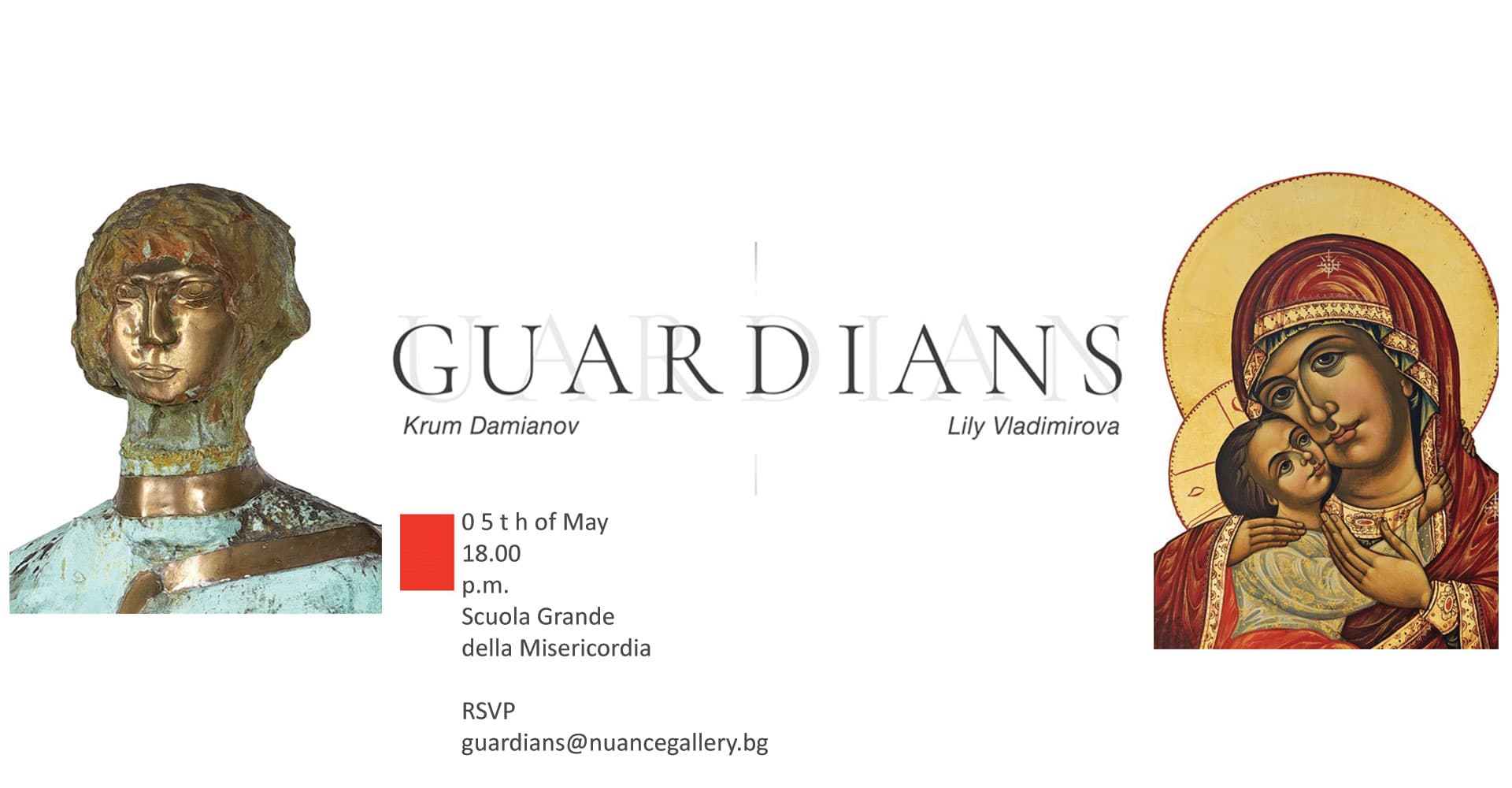
Two contemporary artists call upon us to reflect in an age when confidence in art’s capacity to raise questions, suggest interpretations and give voice to thought as a means of understanding reality and the meaning of existence has been lost. They use forms of expression apparently very distant from each other: one makes sculptures with a modern, topical language; the other paints sacred images, perpetuating a millennial tradition. What they have in common can be found in the title they gave to this exhibition: Guardians. Guardians are the attentive custodians of the heritage and values entrusted to their care. They stand up in their defense against anyone who threatens them. It is an ancient concept that appears in Plato’s Republic, where the phýlakes are the guardians of the principles constituting the ideal state. They are naturally gifted men and women who are educated to put their qualities at the service of the citizens entrusted to their government. Guardians and helmsmen – the etymology of which means ‘to govern’ – whose responsibility is to protect and guide. Lily Vladimirova Lily Vladimirova is a guardian of the ancient discipline of icon painting. She preserves and passes on its sacredness, its conception of the world. She works in the silence of her studio with wisdom and patience, commanding time. For Tolstoy, patience and time are the greatest attributes of a warrior. Her frame of reference is tradition, i.e. the origin of things. The rigorous technique is an essential part of the ritual: it does not allow for improvisation, digression, omission. The artist chooses the most difficult path: renouncing her freedom. Or rather, she confines it to a dimension with its own language and rules. The shrinking of space does not stifle creativity; on the contrary, it exalts it. The same can be said of poets who choose to submit to the laws of metre, where the constraint is not a limitation, but a challenge that only the great poets can meet. The icon painter operates in the dimension of the sacred, because the icon is a sacred space. The painter is an officiant: God guides the gesture, the stroke, the paint. Light radiates from on high, because that is where God is. The making of the work follows precise steps, measured out by fidelity to tradition and a meticulous attention to detail, because the icon reflects the perfection of the cosmos. Only a great artist can transform the return to ancient roots into contemporary avantgarde art, combining rigor and message. The choice of this expressive form allows Lily Vladimirova to express her vocation. Her painting is metaphysical, a theology of images, where technique is at the service of spirituality. The saints appear to be devoid of muscle and bone. The painter gives them breath, pneuma, inner energy, ethical strength. Everything is symbolic in her art, starting from the choice of wood, the raw material par excellence, which evokes the ancient trade of the carpenter Joseph and his son, Father and Creator. She gives it the form of a tablet, smooths it, reinforces the back with stretchers. A coating of size prepares the wood to accommodate a layer of a white linen fabric, symbol of Veronica’s veil, the archetype of all icons, on which remained impressed the face of God incarnate. White is the color of God, the divine light that illuminates the darkness, the fiat lux of Genesis 1,3. The preparation continues with the application of various primer coats, a base paint used to ensure the uniformity of the final coat of varnish. After careful sanding and polishing, Lily traces the contours of the design with a pencil and then engraves them, committing them indelibly to the board. At this point Lily performs the bolus gilding, a sophisticated technique that involves the application of 22 kt gold leaf at the designated points, prepared with eight layers of red clay. Gold indicates the royalty of God, “Lord of Heaven and Earth, of all things visible and invisible”, because in the sacred space of the icon the task of the artist is to make visible what is invisible. The whole is perfectly smoothed with an agate burnisher and sealed with a coat of varnish. The final rite of the breaking of an egg alludes to the creation of the universe, a cosmogonic archetype well known to ancient religions. The yolk, separated from the albumen and diluted in water, will be mixed with the different natural pigments, prepared by grinding mineral and vegetal sources to become egg tempera paint. Rituality and spirituality. Lily chooses to work in this context, to lend her talent to this dimension. The West has largely lost the sense of the sacred, while our cities, towns, districts and crossroads tell us of an era in which people had a different relationship with God. Upon entering a consecrated space, we should put ourselves in the shoes of those who created it and lived it for centuries and not behave like tourists ambling through the rooms of a museum. We go looking for beauty and allow ourselves to be seduced by the fame of a work or an artist, while we should be interested in what that work represents, what conception of the world it fits into. Without this approach we cannot ever understand Giotto’s Arena Chapel or the Brera Altarpiece, with the cosmic egg painted there by Piero della Francesca. Our identity is rooted in this reflection: in the global world, in order to relate to other people, we need to understand their customs, lifestyles, worldview, culture – that is to say, their identity. It is a process we call enculturation: it is obvious that one perceives a difference if one has clear terms of comparison. To understand others, we must therefore ask ourselves who we are and know our own history and the conception of the world that makes us think and reason in a given way. We are children of the ancient Greeks and of Christ. We must be guardians of all of this, we must safeguard, preserve and protect it. Tutelage is an inherently precious gesture, it is an act of goodness that requires knowledge and patience, rigor and creativity, ritual and spirituality, ancient gestures relived in a timeless yet modern dimension. This is the path chosen by Lily, who innovates tradition with the strength of her talent and femininity. Thus, in representing the Panagia Glykophilousa, or the ‘Loving Kindness’ icon, Lily adds a veil of melancholy to the tenderness of Guardians 7 maternal love. It is a presentiment of the Passion and sacrifice that await the infant Jesus, who brings his face to his mother’s and smiles, as if to comfort and soothe her. Krum Damianov The voice of Krum Damianov has an epic dimension, which connects him directly to the ancient roots of his land. His sculptures have the expressive power of Homer. He is a cantor, a prophet in the etymological sense of the word (‘he who speaks prior’, who admonishes the conscience, who anticipates events). While Lily works in the intimate dimension of dialogue with the divine, Krum fights with the ferocity of a man who sees an imminent threat, a violent and brutal enemy. Lily’s energy is all internal, like that of her saints; Krum instead frees his energy in space with such fury that the figure itself is thrown into turmoil, crushed, broken, torn. It is as if the artist wanted to discover the physical limits of sculpture, to find another dimension for it through dynamism and movement in space. This quest, this anxiety to dominate space, recalls a master much admired by Krum: Picasso, whom the sculptor has portrayed many times, capturing his restless and forward-thinking spirit by focusing on his dark, penetrating, visionary eyes. In June 1937, the year Damianov was born, Picasso denounced the brutality of a criminal government that massacred a defenseless population with Guernica. In the large canvas, originally exhibited in the Spanish Pavilion at the Universal Exposition in Paris, Picasso paints the torment of a mother and the bull’s indifference to the pain he himself has caused. The bull symbolizes the primal, brute force that humanity has been fighting against since time immemorial, epitomized by bullfighting. It is the Minotaur who claims the tribute of blood and whom only Theseus, hero of rationality and intelligence, can succeed in killing. The bull looks away from the picture, ignoring the screams of the mother who holds the dead body of her child in her arms. For Krum, the greatest enemy of humanity is indifference, turning away, shutting oneself off in selfishness, washing one’s hands, like Pilate. Elie Wiesel’s words on indifference come to mind: “Indifference to evil is evil. The opposite of love is not hatred, but indifference; the opposite of life is not death, but indifference; the opposite of intelligence is not stupidity, but indifference. We must fight against it with all our might”. The standing figures, arranged along the book that contains the icons of Lily Vladimirova, are clear representations of indifference. They have one thing in common: they rub their hands, like so many Pontius Pilates who, like the ancient Roman procurator, refuse the courage of ethical choice, to do what they feel is right, allowing what is happening or what is about to happen to continue, closed in the embrace of their own selfish indifference. These sculptures represent the exact opposite of the commitment to truth, of the courage of guardianship. They are the symbol of the evil of our time, of an era that has lost the defining values of humanity. A group of meerkats standing upright on their hind legs, all looking in the same direction. They do not scour the horizon to ward against enemy attacks, but stare incredulously, astonished, at a man’s head endowed with brain. A rarity! The artist wants to shake us up. The horrors of war have dehumanized us. We are in the biblical dimension of pain. It is as if universal pain were echoed in Krum’s mind and hands, shouting out a warning. Art cannot ignore reality, and the reality of history is a series of horrors. The tragedies of the 20th century belong to the realm of concreteness, enemy of hope. Art teaches us to see, obliges us not to be indifferent or distracted, requires us to trust in life and the strength of culture. The salvation of humanity comes through education in the fundamental values on which human society is based, symbolized by music, platonically understood as the totality of the forms in which the Muses express themselves. The symbolic embodiment of the power of music is Orpheus, born in the same land and under the same sky as Krum Damianov. The mythical singer is certain that light will ultimately triumph. As for the barbarians, as Paul Éluard writes in his poem La victoire de Guernica, “nous en aurons raison” (we shall prevail on them”). The artist’s relationship with tradition is revealed in these words: “I change the meaning, the interpretation, the content of what is well known. I venerate tradition and dialogue with tradition. It’s like a glance in the rear-view mirror that allows you to move forward”. Thus, the innovation in his work “is to find another proportion, different from the ancient canon, in both artistic means and methods, which remain relatively unchanged for a long period in the history of art”. In this, his artistic commitment is both similar and different from that of Lily Vladimirova. Both artists talk to us in this exhibition about decisive themes. Krum disturbs us, unsettles us, slaps us awake; Lily soothes us, comforts us, consoles us. The agonized sculptures of Krum, which combine ceramics, bronze and aluminum to amazing effect, dialogue in this exhibition with the light, the charm and the inner serenity of Lily’s icons. She is the guardian of tradition and identity, while he denounces indifference and the threat of barbarity. Both artists assign to art its rightful responsibility. They are our guardians. Giuliano Pisani classical philologist and art historian